Delivering timely and actionable insights demands robust data architecture.
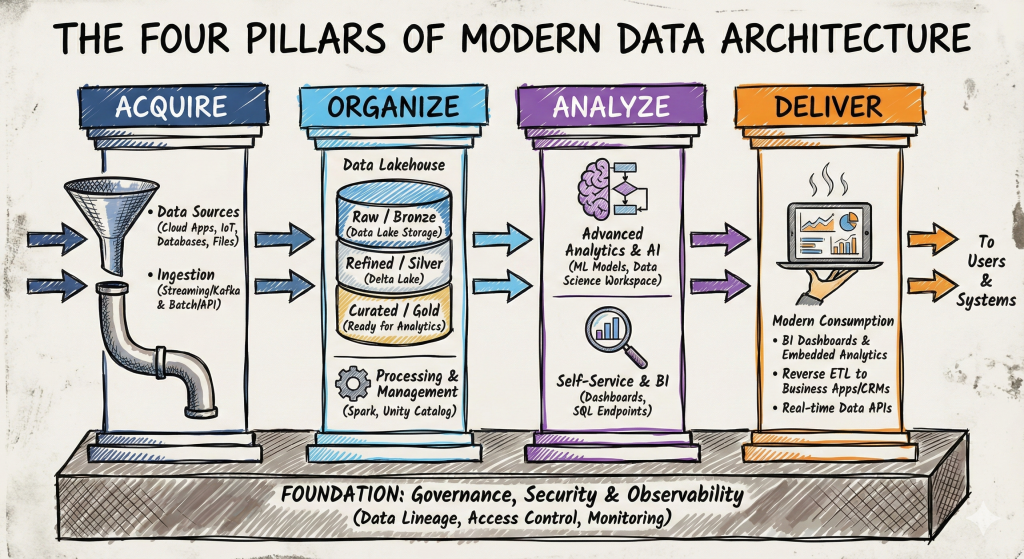
I’ve used a form of this visualization for years to highlight how I approach data and analytics. On the backend, “Acquiring” and “Organizing” data requires accessing data in a variety of ways. Traditional ETL loads and updates incrementally to data warehouses or data lakes. I’ve used multiple ETL/ELT tools to pull data from relational OLTP systems and extracts into a data warehouse/data lake where it can be transformed to support dimensional modeling. “Analyzing” and “Delivering” data involves a Semantic layer (e.g. often a well-formed OLAP cube) to serve as a single source of truth for Business Analysts, BI Developers and Data Scientists.
The compute engine generally uses a proprietary syntax (e.g. DAX in Power BI, Calculation Syntax in Tableau or Set Analysis commands in Qlik) to allow for the efficient slicing and dicing of data. Making sure the transformations and measures are well understood, accurate and consistent is a principal requirement of a professional Data Architect.
To read more, please visit my Medium site.