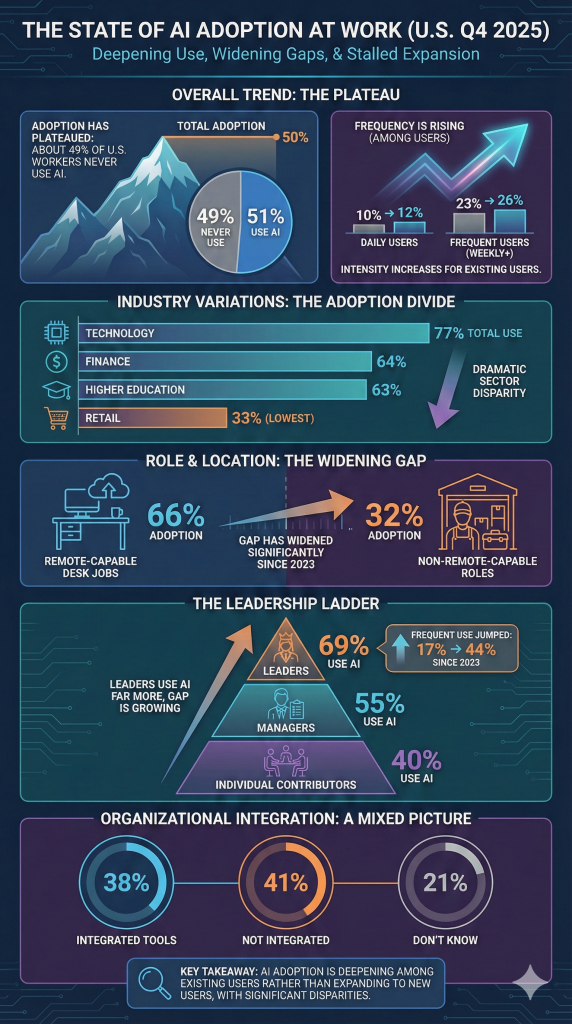
I’ve been following the trends with AI for some time and Gallup recently released new data (January 26, 2026) on AI use in the workplace. This page summarizes the Gallup report “Frequent Use of AI in the Workplace Continued to Rise in Q4”. I post this information as a convenient place for my reference. It might be of interest to others too.
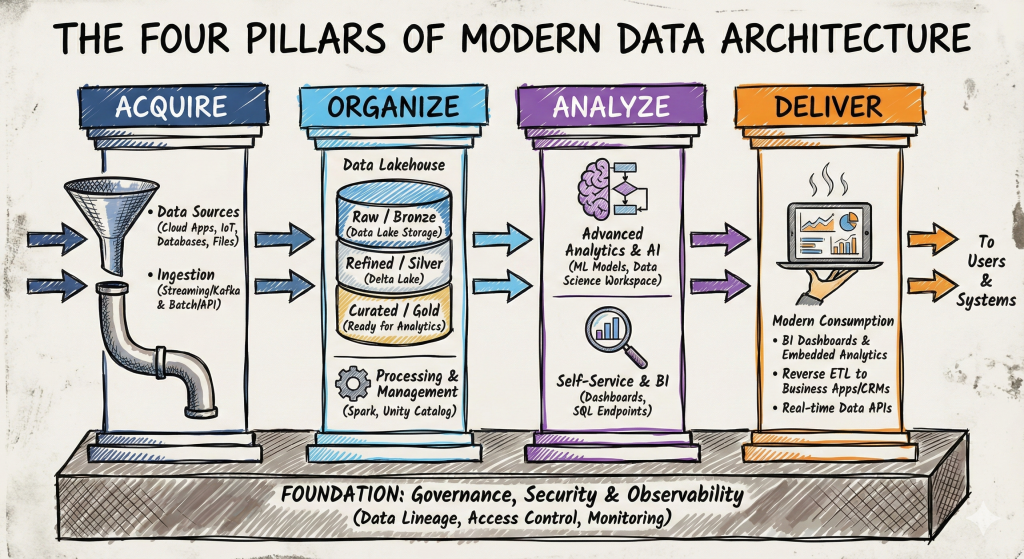
Delivering timely and actionable insights demands robust data architecture.
I’ve used a form of this visualization for years to highlight how I approach data and analytics. On the backend, “Acquiring” and “Organizing” data requires accessing data in a variety of ways. Traditional ETL loads and updates incrementally to data warehouses or data lakes. I’ve used multiple ETL/ELT tools to pull data from relational OLTP systems and extracts into a data warehouse/data lake where it can be transformed to support dimensional modeling. “Analyzing” and “Delivering” data involves a Semantic layer (e.g. often a well-formed OLAP cube) to serve as a single source of truth for Business Analysts, BI Developers and Data Scientists.
The compute engine generally uses a proprietary syntax (e.g. DAX in Power BI, Calculation Syntax in Tableau or Set Analysis commands in Qlik) to allow for the efficient slicing and dicing of data. Making sure the transformations and measures are well understood, accurate and consistent is a principal requirement of a professional Data Architect.
I’ve updated my Custom AI Chat solution and have shared the technical details on Medium. The exercise allowed me to understand better the tradeoffs from building my own RAG based solution – and using a combination of Open AI APIs and Web Search to help with a custom solution.
Open AI releases GPT-5 so it’s time for updates and new functionality to my custom chatbot!
Several months ago, I shared an update regarding my work on a custom AI chatbot. My primary objective was to explore the capabilities of the OpenAI APIs and deepen my understanding of ChatGPT’s functionality.
With the release of GPT-5, I thought I could update my custom AI Chatbot and introduced a couple of new features. More details are available on my Medium page!
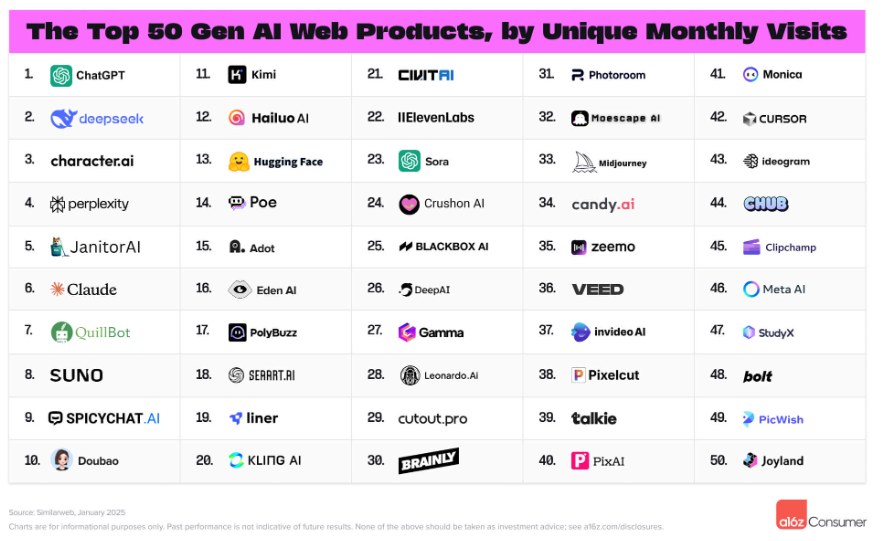
In March 2025, Andreessen Horowitz released the 4th Edition of their Top 100 Gen AI Apps. If you’re curious about where generative AI is making an impact with everyday users, this latest report is worth a look. This edition continues ranking the AI-first apps that are getting usage through millions of web visits or active mobile users. There are familiar names like ChatGPT and Claude, but also some fast risers like DeepSeek and AI video/audio tools that are reshaping how people create and consume content.
a16z also introduced a “Brink List” for apps that haven’t hit the top 100 yet but are showing breakout potential. There is a podcast hosted by Olivia Moore and Anish Acharya.